Analysis Summary
Several analyses needed to be done to ensure the bridge met the project requirements (listed below) Various engineering concepts were used such as statics to create free body diagrams and balance forces, mechanics of materials to calculate deflection, forces in members, and dynamics to determine the bridge under motion.
Project Requirements
-
32mm by 25mm block must traverse the bridge in under 10 seconds.
-
Midpoint of road deck must be 140mm above horizontal resting position when articulated.
-
Abutments are 60mm wide and made of steel and are 400 mm apart.
-
Bridge must be longer than 400mm to rest on abutments.
-
38mm wide solid balsa road deck.
-
10 gram mass on articulation component allowing gap for printer paper to slide under bridge
-
Supports load between 18.9 to 20 kg.
-
Weight of bridge must be 85 grams or less (with articulation hard components removed)
-
Max vertical deflection of 25 mm
-
Ascend/descend of bridge must be done with push of button/lever.
-
Articulation from fully closed to fully open must be done in under 60 seconds.
-
Bridge must be only made from 2 materials: balsa wood and wood glue (excluding articulation components)
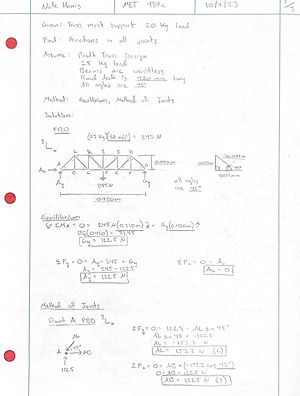


One requirement was that the bridge needed to support a load of 20 kg. The method of joints was used to analyze the forces in each of the members of the truss. It was found that the largest force a member experienced was 367.5 Newtons in compression and 245 Newtons in tension.


The bridge is required to support a load of 20 kg. Using the forces acting on each member that were calculated, as well as information from MatWeb, it was determined that each truss must have a cross sectional area of 3/8 in. by 3/8 in. (9.525 mm by 9.525 mm).

The total mass of the bridge was required to be less than 85 grams. The mass of the trusses was found by finding the total length of balsa wood needed for the trusses, therefore allowing for the base, height, and width to be known, allowing for volume to be calculated. Using the density of balsa wood, the total mass of the bridge was calculated to be 54.98 grams.

The bridge must full ascend/descend in under 60 seconds, and therefore the motor had to be able to handle the power it takes to articulate the bridge. The power of the motor was found to be 1.59 Watts, and the bridge was found to need 0.0069 Watts to articulate, meaning the motor selected has the power to articulate the bridge in 1.26 seconds.


The bridge could have a max vertical deflection of 25 mm. Using the dimensions of the truss and a point load of 245 being applied to the bottom center of the truss, the deflection of the truss was calculated using the virtual work method. The truss was calculated to deflect 0.726 mm